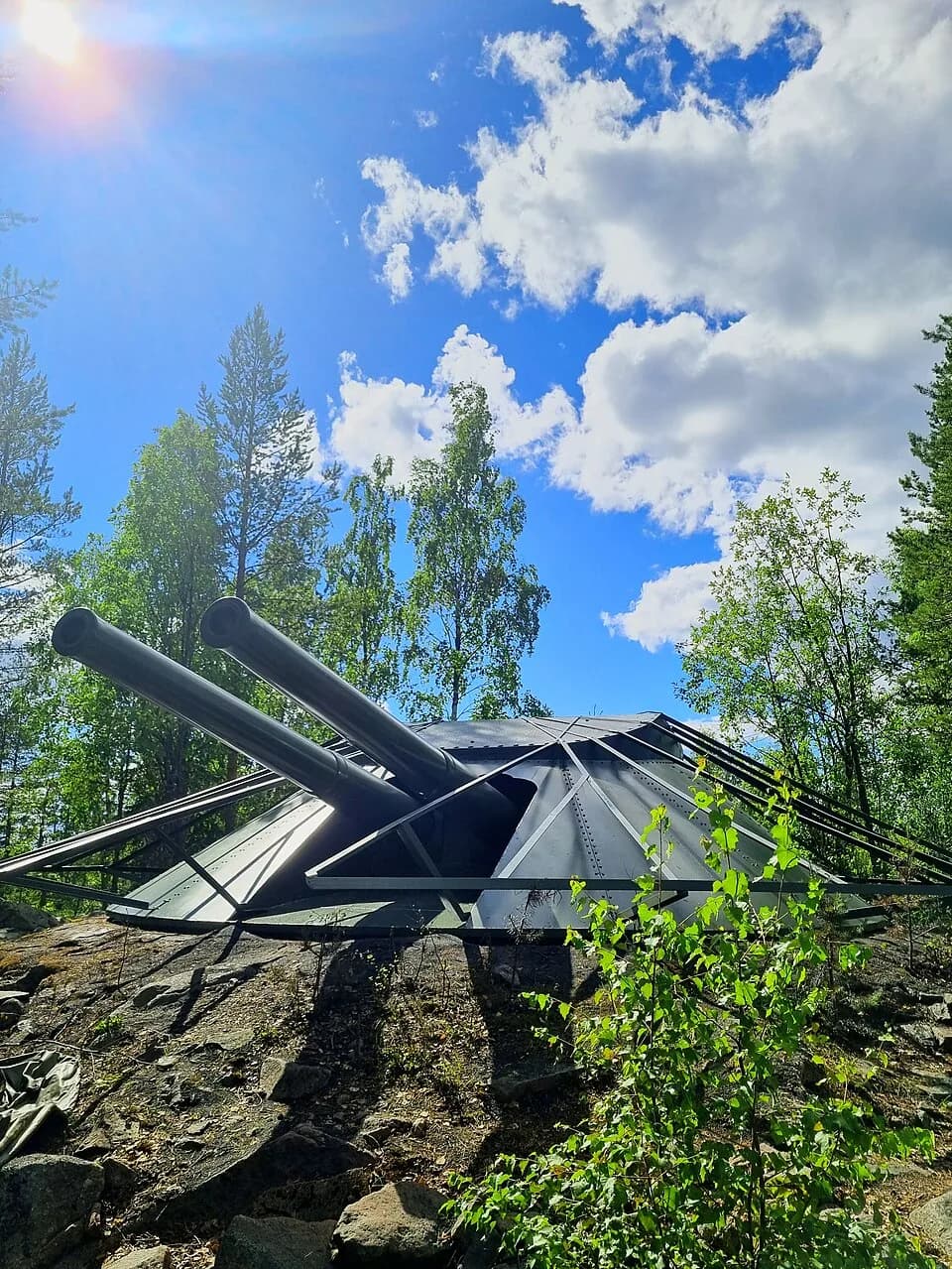
SIKNÄS BATTERIES 1–4
THE HISTORY OF SIKNÄSFORTET
From Cold War batteries to a museum open to everyone
Four batteries on the Siknäs peninsula
Siknäsfortet originally consisted of four artillery batteries. A battery is a group of guns that can direct coordinated fire at the same target, with bunker rooms underneath. These installations are commonly called forts. Today the museum includes battery 1, preserved inside and out, and the neighbouring battery 2, whose exterior is preserved.
The batteries were intended to defend Töre harbour, Sweden’s northernmost natural deep-water harbour, and delay an enemy advance towards Boden along what was then national road 13, now the E4. The fortress was the largest of the Kalix Line’s roughly 3,000 installations.
Built in 1953–1960 with guns from Fylgia
The four batteries were built in 1953–1960 as a public employment relief project. They stand 62–67 metres above sea level and together had a complement of 322 men. This elevation describes their position above the sea, rather than their depth underground.
Each battery received a twin turret with two 15.2 cm guns from the armoured cruiser HMS Fylgia. The ship’s four turrets thus took on a new role in the defence of Norrbotten.
Protection and daily life underground
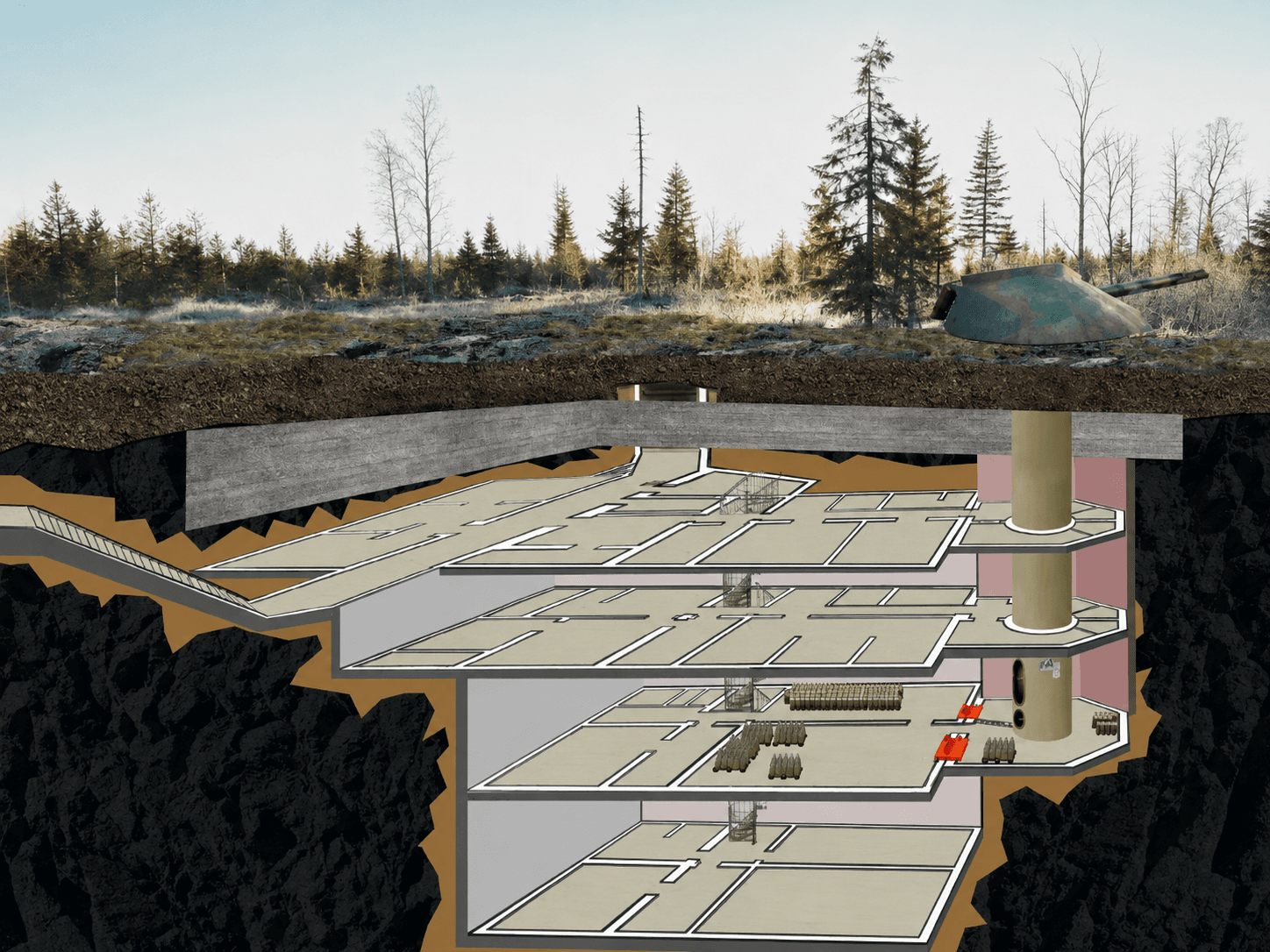
Each battery installation was built in concrete with three or four floors. The concrete structure stands clear of the surrounding rock and rests on springs to limit the transmission of shock waves through the rock. The batteries had protection against atomic, biological and chemical weapons, known as ABC protection.
Below the turret were a command centre, the loading mechanism known as the stjälken, and ammunition stores. The personnel had living quarters, a kitchen and mess, toilets and showers. Backup power and a dedicated drilled well supplied electricity and clean water if outside supplies were cut off.
Defence around the batteries
At times, 20 and 40 mm anti-aircraft guns were deployed near the batteries. Army defensive units and the Home Guard provided close defence. Their firing positions, shelters and some communication trenches were blasted into the rock.
The last wartime unit exercise took place in 1990. Batteries 3 and 4 were removed from the wartime organisation in 1992, followed by batteries 1 and 2 in 1998.
From closure to museum
1999–2003
The Swedish Fortifications Agency (FORTV) began disposing of turrets 3 and 4 in 1999. They were cleaned up and sealed on 4 December 2003. The ground was levelled and replanted.
2005–2008
In 2005, FORTV asked the Swedish National Heritage Board to have turrets 1 and 2 designated as state historic buildings. In 2008, the government decided against preserving the installations and their surrounding close-defence works under that designation, partly because of the cost.
2009
Turret 1 was prepared for a new owner, while turret 2 was cleaned up and sealed. Following consultation with and approval from the Ministry of Culture, the installation was to receive new management as a museum, supported by the Swedish National Museums of Military History through Swedish Military Heritage (SMHA).
2011–2012
FORTV renovated the interior of turret 1.
2013
The Siknäsbatteriet ownership group bought the installation in the autumn and made it available to the museum association.
2014
The association cleaned and refurbished turret 1 during the spring. The museum, part of SMHA, opened to the public on 1 July. That autumn, the ownership group donated its shares to establish Stiftelsen Siknäsfortet. The foundation owns the installation, and the museum association runs the museum.
Fortress cross-section
Milestones in the history
1939–1945
World War II
Sweden maintains armed neutrality. Military planners recognize the vulnerability of Töre harbor — Sweden's northernmost deep-water port.
1953–1960
The four batteries are built
Four artillery batteries are built on the Siknäs peninsula to defend Töre harbour and delay an advance towards Boden.
1960
Fortress becomes operational
Each battery has a twin turret with 15.2 cm guns from HMS Fylgia, rooms on three or four floors, backup power and its own well.
1983
The first submarine hunt
Swedish naval forces detect suspected foreign submarine activity in the Kalix archipelago. A massive submarine hunt is launched.
1987
Second submarine hunt
The incident repeats — among the most dramatic moments of Cold War tension in the Nordic region.
1990
HMS Spiggen II built
Sweden's only domestically built mini-submarine. 11 meters long, used for submarine hunt exercises.
1992–1998
The batteries leave service
After the last wartime unit exercise in 1990, batteries 3 and 4 leave the wartime organisation in 1992. Batteries 1 and 2 follow in 1998.
2013
The installation is purchased
The Siknäsbatteriet ownership group buys the installation in the autumn and makes it available to the museum association.
2014
The museum opens
After the association’s spring refurbishment, the museum opens on 1 July. That autumn, the owners donate their shares to establish Stiftelsen Siknäsfortet; the association continues to run the museum.
2025
AI guide Stig launched
The museum introduces Stig, an AI-powered guide character — one of the first AI-integrated museum experiences in Scandinavia.