A warship and a school at sea
Fylgia was launched in 1905 and entered service in 1907. Launching put the hull into the water; further work was needed before the ship could begin service. As an armoured cruiser, she was a warship protected by armour and intended for scouting, combat and training.
Training became an important part of her long career. Over 40 years, Fylgia made more than 20 foreign expeditions. Cadets practised seamanship aboard her during these voyages.
From white to grey
Fylgia’s appearance changed over time. The early ship had a white hull and yellow funnels. During her modernisation in 1939, she received grey paint. A photograph from 1945 in the Swedish Maritime Museum’s collection also shows the white band that marked Sweden’s neutrality. Photographs from different years can therefore show the same ship looking quite different.
Fylgia was retired in 1953 and subsequently used as a target ship. In 1957 she was sold for scrapping. Her hull was lost, while part of her armament found a new purpose ashore.
Four turrets became four batteries
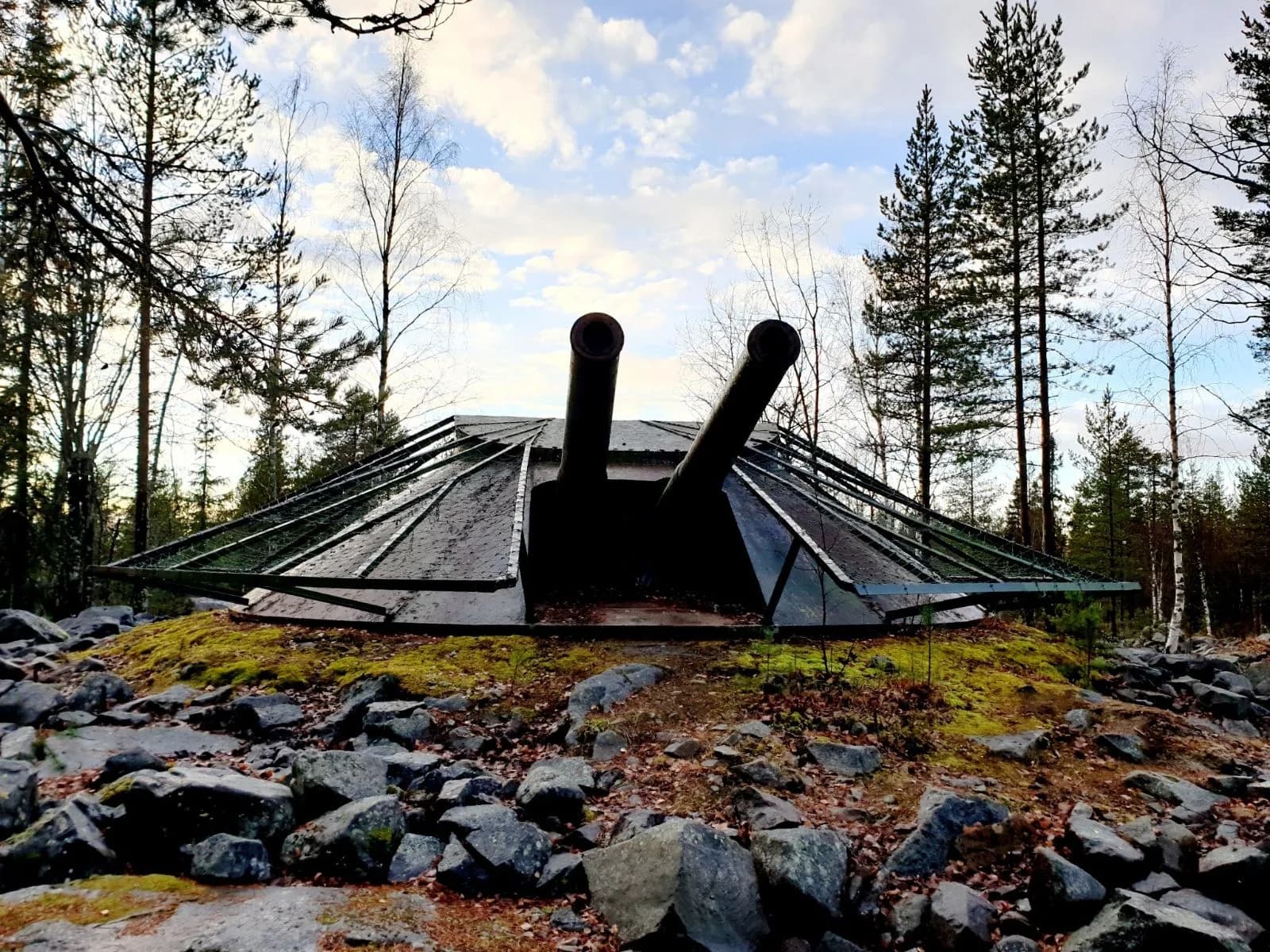
Fylgia carried eight 15.2 cm guns in four twin turrets. A twin turret houses two guns in one protected, rotating structure. When the Siknäs batteries were built between 1953 and 1960, all four turrets were reused: each battery received one turret containing two guns.
The measurement 15.2 cm is the calibre: the internal diameter of the barrel. Here, a battery means a military unit with guns, crews and supporting equipment. The turret visible above ground is just one part of the entire installation.
This allowed naval artillery to serve in fixed defensive positions. The turrets stood above underground rooms that accommodated the crews and the rest of the battery’s operations. The connection between the cruiser and Siknäs is tangible: eight gun barrels from one ship were distributed among four batteries.
On a visit to Siknäsfortet, you can see one of these twin turrets. It helps explain how naval equipment continued to serve in Sweden’s Cold War defences. Read the fortress history to discover the batteries’ later story, or take the VR tour to see how the rooms inside the fort fit together.